Mind Uploading (Whole Brain Emulation)
What is Mind Uploading?
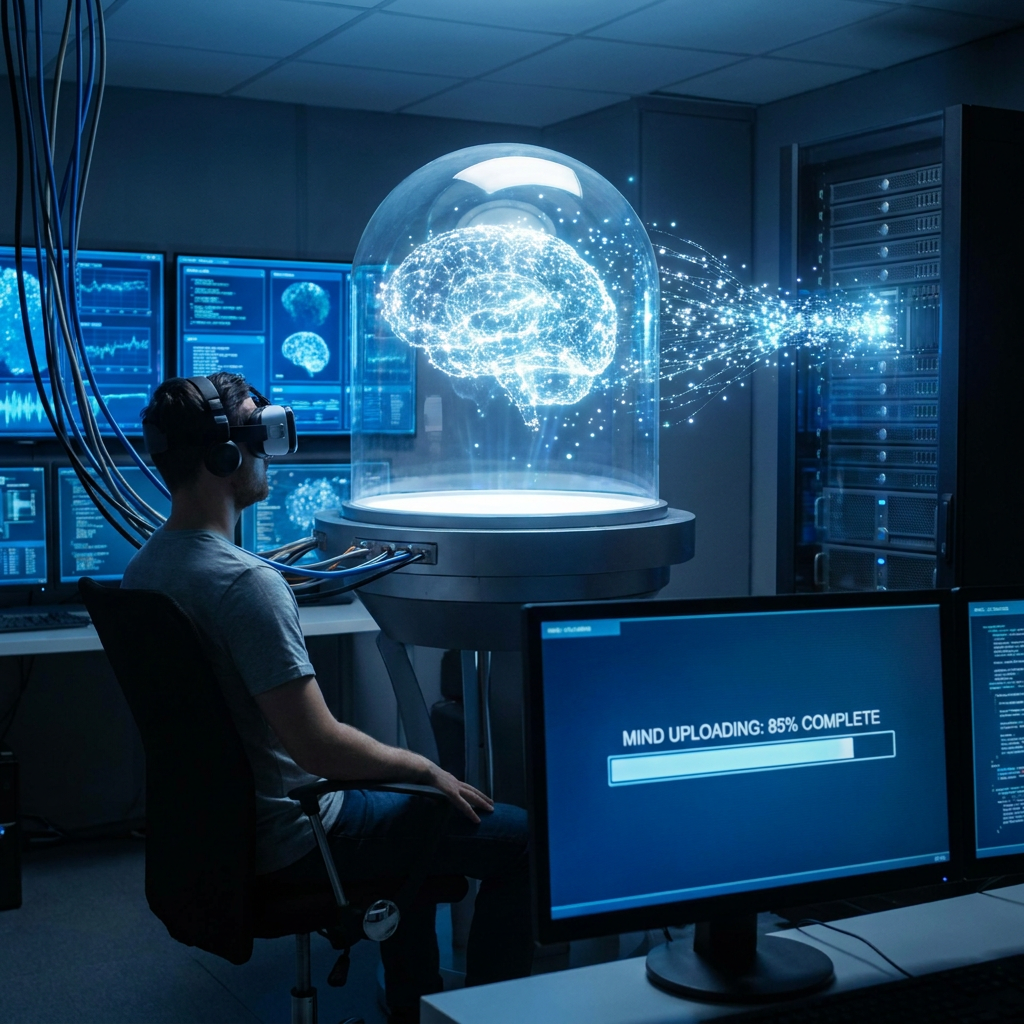
Mind uploading, also referred to as whole brain emulation (WBE) or substrate-independent minds, is a futuristic hypothesis aiming to copy a human brain into an artificial system.
While the concept of mind uploading first appeared in science fiction — notably Arthur C. Clarke's The City and the Stars (1955) — it received its first sustained scientific treatment in Hans Moravec's Mind Children, which described a procedure for scanning and replicating the brain's structure in a machine.
Though no such technology exists, mind uploading is one of the most ambitious, radical, and controversial concepts of the transhumanist project, raising
profound ethical and philosophical questions about identity, consciousness, and the nature of selfhood.
In his book Mind Children, roboticist Hans Moravec argues that the essential
feature of human identity is not the biological material itself, but the informational pattern produced by the brain. According to this informational view of
identity, a sufficiently detailed simulation of the brain could preserve memories, personality traits, and cognitive abilities. The biological body would then
become merely a temporary vehicle for an informational structure capable of existing in more durable technological forms.
In 2008, two prominent figures in transhumanism, the Swedish philosopher Nick Bostrom and neuroscientist Anders Sandberg, described whole brain emulation as a possible future technology in which the structure and functioning of a biological brain are scanned and reproduced within a computer system.
Sandberg argues that whole brain emulation 'represents a formidable engineering and research problem'.
In his book The Singularity Is Nearer: When We Merge with AI (2024), Ray Kurzweil predicts that humans will seamlessly merge with artificial intelligence and computational systems by the 2030s,
"The terms whole brain emulation, mind uploading and substrate independent minds have been used informally in recent years to describe a set of related ideas regarding hypothetical possibilities for transferring or emulating the functioning of a human's brain or mind on a synthetic substrate. " International Journal of Machine Consciousness 4 (01), 23-34
The Process
The uploading idea assumes the mind is an informational system. This concept rests on the process of scanning and mapping a biological brain in extreme detail,
then transferring its structure, neuronal connections, and electrochemical states into a computer system or robotic substrate — effectively "migrating" a mind
to a non-biological medium.
In most models, this would be achieved through a surgical procedure involving microscopic nanobots that map, replace, and emulate
individual brain cells with digital components, gradually substituting biological tissue with functionally equivalent hardware.
Current State of Research
Despite decades of speculation, mind uploading remains entirely theoretical: no human mind, nor any complex animal mind, has ever been transferred to a digital substrate. Nevertheless, efforts in multiple areas of ongoing research, including neuroscience, nanotechnology, and artificial intelligence, are gradually being deployed to build the foundations the concept depends on.
The EU’s Human Brain Project and Switzerland’s Blue Brain Project pioneered large‑scale brain modelling and neural simulation, laying important groundwork for the idea of whole brain emulation. The Human Brain Project produced mixed results: its initial ambition to simulate the entire human brain was widely criticised by neuroscientists as unrealistic, and in 2014 nearly 800 researchers, including Nobel laureates, signed an open letter denouncing its governance and scientific direction. A mediation committee largely validated these criticisms, leading to a major restructuring in 2015 that redirected the project toward building shared digital infrastructure, such as the Human Brain Atlas, rather than attempting a full brain simulation. Blue Brain, its Swiss predecessor, adopted a narrower and more sustainable strategy: instead of targeting the human brain, it focused on constructing and validating a detailed digital reconstruction of the mouse brain, a more modest but scientifically grounded milestone.
In October 2024, the FlyWire Consortium published the first complete connectome of an adult fruit fly brain, mapping over 50 million connections between more than 130,000 neurons — the most complex brain ever fully wired-mapped. Brain-computer interfaces such as BrainGate have separately made progress on the input/output side, enabling thought-based cursor control and communication in clinical trials since the early 2000s. New imaging methods, including ultra-high gradient MRI for connectomics published in 2025, aim to close the resolution gap needed for whole-brain mapping in larger organisms.
Another emerging field progressing in parallel is brain-computer interfaces (BCI), notably driven by Neuralink, the company founded by
Elon Musk and a team of engineers. After an initial rejection over safety concerns, the FDA approved Neuralink's first human clinical trial
in 2023, and the company implanted its first human patient in January 2024, a paralyzed man able to control a computer cursor by thought.
Since then, Neuralink has significantly expanded its human trials. As of early 2026, over 20 participants worldwide were enrolled, with the
company reporting no serious device related adverse events. Neuralink is also developing a second device, Blindsight, aimed at restoring vision
by directly stimulating the brain's visual cortex. Blindsight received FDA Breakthrough Device Designation in September 2024, a status that
accelerates regulatory review but does not constitute approval. The device has so far only been tested in non human primates, and the first human
implant is expected sometime in 2026.
According to the FDA's website, on July 21, 2026, a meeting took
place between FDA officials and Neuralink executives, including company president Dongjin Seo, to discuss regulatory pathways for accelerating medical device innovation.
As of August 2026, a search on ClinicalTrials.gov
lists seven clinical trials involving Neuralink, four of them are geographic variants of the same core study (PRIME), replicated in the United
States, the United Kingdom, Canada, and the United Arab Emirates to broaden patient recruitment and satisfy different national regulators.
The remaining trials include VOICE, focused on speech restoration, and two smaller studies evaluating assistive-device control and long-term clinical
outcomes. Nearly all are actively recruiting, spanning academic medical centers across four countries, with each targeting patients affected by
conditions such as ALS, spinal cord injury, or quadriplegia.
These clinical trials remain fundamentally different from mind uploading. Neuralink's implants read and write narrow slices of neural activity, enough to move a cursor, form words, or restore basic vision, but they capture nothing resembling the full structure of a mind. Closing that gap remains the central unsolved challenge between today's brain-computer interfaces and any future vision of digital immortality.
Neuralink is not the only player in the field of brain-computer interfaces, Shanghai-based StairMed Technology is developing a less invasive, endovascular implantation method, inserting a chip through blood vessels in the neck and guiding it to the brain via the vascular system, similar to how a stent is placed.
Paradromics, widely seen as one of Neuralink's closest rivals, received FDA approval for a long-term clinical trial and will implant its device in two volunteers in early 2026, aiming to restore real-time speech for people with severe motor impairments.
On the brain emulation side, the academic FlyWire Consortium completed the first full connectome of a fruit fly brain in 2024, mapping every neuron and synaptic connection. Building on that achievement, the company Eon Systems brought the map to life: in 2026, it ran the first simulated fruit fly brain controlling a virtual body, with a mouse‑brain emulation set as its next milestone. Taken together, these efforts illustrate the two main technological pathways toward mind uploading: interfacing with the brain and emulating it.
Advanced imaging is also making strides on another front: non-invasive scanning of the living human brain. In 2025, researchers at Massachusetts General Hospital and Harvard Medical School introduced Connectome 2.0, an ultra-high-gradient MRI scanner capable of resolving microscopic brain structures in living humans without surgery. While its resolution has yet to achieve synaptic-level precision, it represents a groundbreaking, non-invasive approach to brain connectomics, eliminating the need for implants or tissue destruction.
The gap between these advances and mind uploading itself remains vast. As of early 2026, scientists cannot yet replace a single real neuron with an artificial one, and no human mind has been successfully uploaded or emulated. Estimates for when — or whether — whole brain emulation might become achievable vary widely, from a few decades to as long as 100 to 200 years, with most researchers cautioning against near-term expectations of virtual immortality.
Mind Uploading and Virtual Immortality
Mind uploading is a cornerstone of virtual immortality, and together, the two concepts form key pillars of transhumanist thought. Virtual immortality depends entirely on whether mind uploading proves feasible. Without the ability to accurately capture and replicate the intricate workings of the human brain, the dream of escaping death by migrating to a digital or synthetic existence remains, for now, purely theoretical.
The Copy Problem
The most profound philosophical dilemma of mind uploading and virtual immortality is the copy problem: even with a perfect, neuron-by-neuron digital reconstruction, it remains unresolved whether this process achieves continuity of consciousness or merely creates a high-fidelity duplicate. If your mind is uploaded into a machine, does your subjective experience persist—or is the resulting entity merely a replica, while the original biological "you" ceases to exist? Without resolving this, the promise of virtual immortality remains fundamentally unproven.
" Can the original biological person be left alive, or should we apply euthanasia to avoid his or her simultaneous living with the digital duplicate? If both continue to “live” for a while, which of the two is the repository of the rights and responsibilities acquired by the first? . " AI & Society. 39, pages 389–394 (2024)
Academic Publications
- 2024 "A free mind cannot be digitally transferred." JAI & Society 39, pages 389–394 (2024). Journal Link
- 2023 "Would you exchange your soul for immortality?-existential meaning and afterlife beliefs predict mind upload approval" Front Psychol. 14:1254846 PubMed
- 2008 "Whole Brain Emulation: A Roadmap." Future of Humanity Institute Report Link
- 2010 "The Singularity, A Philosophical Analysis." Journal of Consciousness Studies 29–10, 2010, pp. 7-65 Journal Link
- 2012 "A framework for approaches to transfer of a mind's substrate." International Journal of Machine Consciousness 04, No. 01, pp. 23-34 Journal Link
- 2012 "Introduction" International Journal of Machine Consciousness. 04: 1–3. Journal Link
-
2012
"Coalescing minds: brain uploading-related group mind scenarios"
International Journal of Machine Consciousness.
04 (1): 293–312.
Journal Link
- 1995 "Facing up to the problem of consciousness" Journal of Consciousness Studies 2 (3):200-19 (1995) Journal Link
Related Projects
- The EPFL’s Blue Brain Projec (2005-2024) A Swiss national brain initiative aiming to simulate the mammalian brain at cellular level. Project's website
- Human Brain Project (2013-2023) An EU-funded initiative to understand the structure and function of the human brain. Project's website
- Carboncopies Foundation A non-profit organization dedicated to advancing whole brain emulation. Foundation's website
- The FlyWire Consortium A human-AI collaboration for reconstructing the full brain connectome of Drosophila. Consortium's Website
- Eon Systems Eon Systems is a San Francisco-based neurotechnology company focused on whole-brain emulation and "mind uploading". its is Led by Michael Andregg. Visit Eon Systems
- Neuralink A neurotechnology company founded by Elon Musk and a team of engineers, developing a fully implantable brain-computer interface called "The Link" to enable direct communication between the human brain and computers. Visit Neuralink
- StairMed Shanghai StairMed Technology is an innovative technology company specializing in implantable brain-computer interface technology. Visit StairMed Technology
Press Articles
- 2026-05-15 "Silicon Valley Wants to Put a Chip in Your Brain" Politico
- 2025-11-28 "Paradromics Gets FDA Approval to Trial Its Brain Implant in People" WIRED
- 2025-11-20 "FDA approves Paradromics’ brain-computer interface trial for speech restoration" STAT
- 2025-11-10 "Investors’ ‘dumb transhumanist ideas’ setting back neurotech progress, say experts" The Guardian
- 2025-05-16 "Coming to a Brain Near You: A Tiny Computer" The Wall Street Journal
- 2025-05-23 "Can you upload a human mind into a computer? A neuroscientist ponders what’s possible" The Conversation
- 2024-05-10 "What You Need To Know About Brain-Computer Interfaces" Forbes
- 2020-02-27 "Why your brain is not a computer?" The Guardian
- 2019-10-20 "What happens if your mind lives for ever on the internet?" The Guardian
- 2019-10-24 "Mind-reading tech? How private companies could gain access to our brains" The Guardian
- 2018-01-01 "Neurotechnology, Elon Musk and the goal of human enhancement" The Guardian
- 2016-03-14 "The immortalist: Uploading the mind to a computer" BBC